Recent changes have been observed in the Kim Jong-un regime's propaganda apparatus, including the payment of additional allowances and other incentives to grassroots-level "agitators" — the workers responsible for conveying and promoting the Korean Workers' Party line directly to the population. Based on reports from reporting partners inside North Hamgyong Province and Ryanggang Province, this article examines recent shifts in the regime's propaganda and agitation work. (JEON Song-jun / KANG Ji-won)
◆ Who Are the Agitators?
At the Second National Conference of Primary-Level Party Propaganda Workers held in March 2019, Kim Jong-un stated:
"Placing propagandists and agitators wherever the masses are gathered, and raising their role so that one educates and leads ten, and ten leads a hundred, is our Party's unique system of mass education and method of working among the masses."
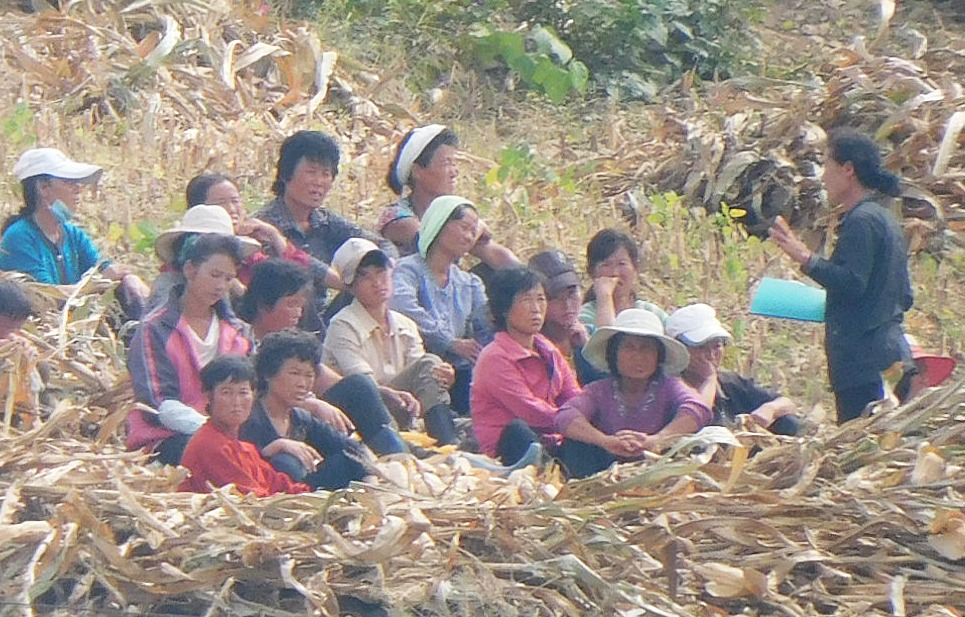
In North Korea, agitators are the lowest-level practitioners of propaganda and agitation work — the people who deliver the Party's voice directly to ordinary citizens. They not only transmit policy but also serve as antennas for gathering public opinion. They are regular workers at their workplaces who carry out agitation duties alongside their regular jobs.
In the past, agitators held a fairly low standing. The position was essentially an unpaid honorary role — a few times a year, they would gather people together to read aloud from a newspaper or recite outdated propaganda slogans — and was mostly taken on by young women. North Koreans generally regarded agitators as little more than errand runners for low-ranking Party secretaries.
Recently, however, authorities have reportedly been improving the treatment of agitators by paying them additional allowances and offering various incentives.
◆ Monthly Allowance of 10,000 Won Added; Experienced Workers Selected Instead of Young Women
Reporting Partner A in North Hamgyong Province reported in mid-January that authorities had issued instructions to substantially strengthen the treatment of agitators.
"Starting in January of this year, agitators are being paid an additional monthly allowance of 10,000 won on top of their regular wages. The Party has instructed that they be treated at the level of 'junior cadres.' The money is only given to those who have received specialized training and been officially appointed directly under the propaganda departments of provincial, city, or county Party committees."
Given that the official wage for North Korean workers sits in the range of 35,000 to 50,000 won per month, an additional 10,000 won allowance is by no means a small amount. The state guaranteeing a "fixed income" equivalent to roughly one-third of an ordinary worker's wages carries both practical weight and significant symbolic meaning.
※ 10,000 North Korean won is equivalent to 0.3 USD (as of late January).
Reporting Partner B in Hyesan, Ryanggang Province, offered similar testimony, noting that the additional allowance paid to agitators has something of a performance-based character.
"They conduct surveys among workers to evaluate how well the agitation work was done. Agitators who earn recognition from the public are given commendations, sent on study tours to Pyongyang, and even rewarded with goods as bonuses — things like bread, cigarettes, and alcohol. They no longer let just anyone become an agitator. In the past it was mostly young women, but now they select people who are older and have relevant experience."
This is interpreted as an effort to invigorate what had long been a largely perfunctory propaganda operation, using a process of selection and rewards tied to public evaluation.