This series has reported over nine installments on the results of a large-scale price survey conducted in four cities in Ryanggang and North Hamgyong provinces in May and June. In Part 10, based on the data collected so far, we simulate the monthly income and necessary expenses of an average ordinary household. Using a three-person family—parents and one child—as our model, we created a "household budget" that reveals the extremely difficult reality facing ordinary residents in provincial cities. (HONG Mari / KANG Ji-won)
◆A Husband Working at a State Enterprise and a Wife Making Wigs All Day—How Much Do They Earn?
Up to this point, we have analyzed the structure and prices of food, processed goods, public utilities in North Korea, as well as state enterprise wages and "contract processing" (imgagang) income. However, essential expenditures—particularly for food—are completely out of balance with household income. Many readers may have wondered: "How exactly do North Korean people manage to survive?"
In this installment, we simulate a May household budget for a three-person family living in Hyesan, Ryanggang Province, to paint a concrete picture of how North Koreans actually live. We present the Park family —a hypothetical family created by ASIAPRESS to represent an average ordinary household in North Korea.
◆A 40-Year-Old Couple and One Middle School Student: Impossible to Survive on Salary Alone
The Park family consists of three members: parents and one child. The husband (age 40) works at a provincial factory. The wife (age 40) is a homemaker who manages household duties while being mobilized twice a week for Women's Alliance meetings and unpaid volunteer labor. In her spare time, she also takes on subcontracting work making wigs.
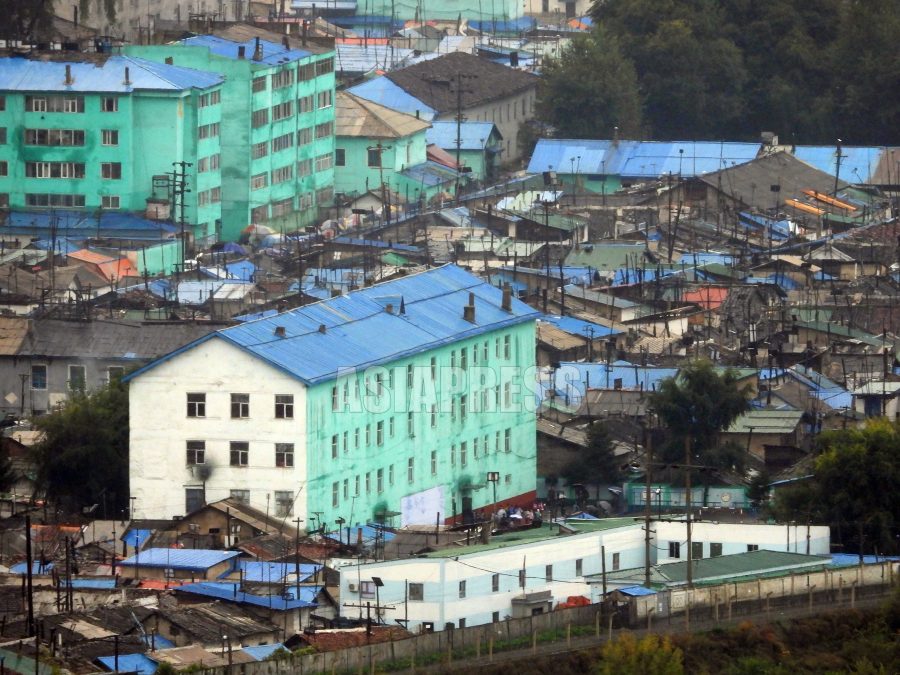
They live in an older apartment in an urban area, and their child is a middle school student. Several times a month, the wife takes a bus to the countryside to check on the husband's elderly mother.
※ Women's Alliance: An organization composed primarily of housewives without workplace employment.
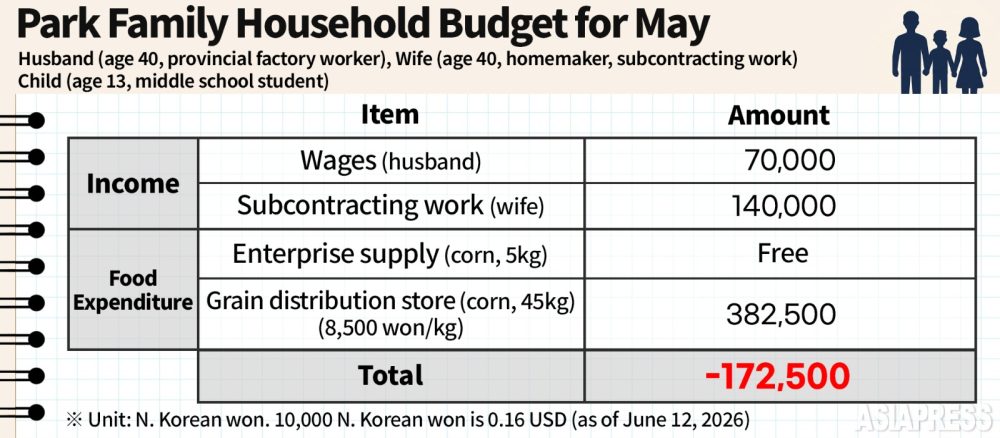
Let's first examine the Park family's monthly income. The husband works at a provincial factory under Ryanggang's jurisdiction. Because sales of their original products have been poor, factory administrators decided to instead produce bread and sell it to state shops and enterprises, generating some profit. The Park family's monthly wage is 70,000 won.
The wife spends every available moment from morning to night making wigs through subcontracting work. Her child also frequently helps after school. Each completed wig earns 35,000 won but takes seven days to produce. Although the husband also helps after work, the family manages to complete only four wigs per month, earning 140,000 won from this work. Combined monthly household income totals 210,000 won.
※ 10,000 North Korean won equals 0.14 USD (as of September 4, 2026, according to ASIAPRESS research).
◆How Much Food Can the Park Family Buy with Their Income?
How much food can this money buy? Based on prices at a grain distribution store in early May when the wife made purchases, corn cost 8,500 won per kilogram. Even if the family spent every bit of their income on corn, they could purchase only 24.7 kilograms. A three-person family needs a minimum of 50 kilograms per month. The husband's workplace provides five kilograms of corn free of charge, but even with this addition, the shortfall is severe.
※ North Korean authorities set daily food requirements at 750 grams for adults, 550 grams for dependents, and 450 grams for elementary and middle school students. This may seem like a large amount. However, in North Korea, side dishes consist mainly of vegetables, meals contain little fat, and people walk or ride bicycles frequently for transportation, making carbohydrate intake essential.
Calculating in reverse, purchasing just the minimum 50 kilograms of monthly staple grain alone creates a massive shortfall of 172,500 won.
◆When Combined with Side Dishes, Utilities, Medical Care, and More...
Of course, families cannot survive on staple grain alone. Money is needed for side dishes (vegetables like cabbage and radish, seasonings like soy sauce and miso), electricity and water bills, transportation, medical care, and other necessities. Even a simple accounting reveals substantial expenses.
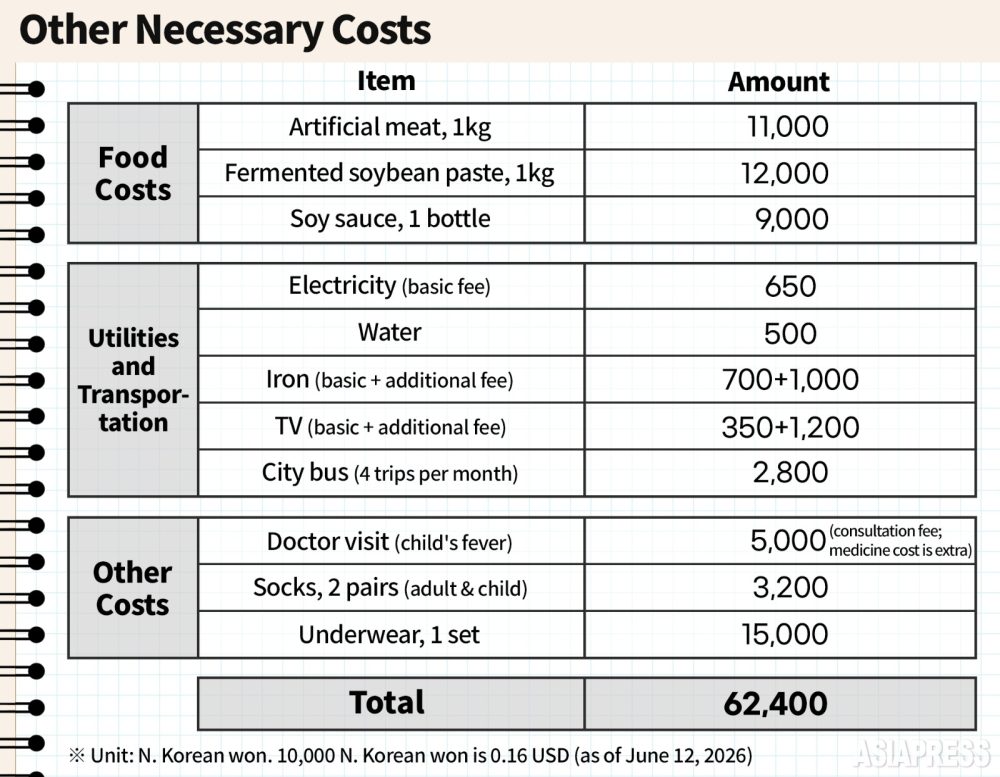
Artificial meat is soy oil cake—the solid residue left after pressing soybeans for oil—that has been hardened and dried. In North Korea, it is a popular, inexpensive, and precious protein source that can substitute for expensive meat and fish. Electricity, water bills, and fees for using an iron and television must be paid every month. The simulation also accounts for the wife taking a city bus to visit her elderly mother in the countryside twice a month, taking the child to a doctor when he has a fever, and purchasing consumables like socks and underwear.
Of course, in reality, families might choose to walk long distances or ride bicycles to save money for food, rely on folk remedies when the child has a fever rather than seeing a doctor, and patch worn socks and underwear to make them last longer. Meanwhile, middle schools often demand that families contribute toward repairs of aging school facilities. There are also unexpected expenses like the father's drinking money and other costs not listed here that could arise.
![Mass Starvations Occurring in the Breadbasket [pdf]](https://www.asiapress.org/rimjin-gang/wp-content/uploads/2018/07/2012-2013_Hwanghae_Report_A-150x150.jpg)