ASIAPRESS conducted extensive price surveys in four cities across Ryanggang Province and North Hamgyong Province in May and June. In the eighth installment of this series, we examine wages at state enterprises. The majority of adult men in North Korea work for state enterprises, and their wages are, in principle, set by the state. But what exactly is this "state-set wage"? What purchasing power does it actually possess? This article explains the latest wage levels and structures. (HONG Mari / KANG Ji-won)
◆State-Set Wages Become Meaningless
North Korea has long implemented a system of "state-set wages" in which the state sets wages uniformly according to job type and labor intensity. This system originally presupposed a rationing system in which food, housing, and energy were provided by the state at low prices as compensation for labor—covering not only the worker but also their family members. Medical care and education were free, and simply by holding a job, an entire family could survive on wages. Each workplace had a rank system based on position, and as workers were promoted, their wages increased.
However, the economic collapse of the 1990s changed everything. As the food rationing system essentially collapsed, the country descended into the social chaos and mass starvation that became known as the "Arduous March." When state-set wages could no longer purchase the food needed for survival, the system collapsed entirely, and most people were forced to engage in market activities to survive. Yet the Kim Jong-il regime continued to compel adult men to report to work. This was to maintain control through workplaces. Wages were either not paid at all or paid in meaningless small amounts; food rations were nearly halted as well—a situation that persisted until recently.
◆A Brief Relief Before Collapse
In late 2023, a major change occurred. The Kim Jong-un regime raised state enterprise wages across the board by more than tenfold. Wages that had been approximately 1,500–2,500 won jumped dramatically to 35,000–70,000 won (described below). Additionally, workers themselves were provided with approximately 5 kilograms of grain per month free of charge. The authorities claimed that with the increased wages, families could now afford to purchase food.
※ Beginning around January 2023, the sale of grain in markets was prohibited, and grain could only be purchased from state grain distribution stores.
※ 10,000 North Korean won equals approximately 0.15USD (as of August 28, 2026).
The regime's policy of raising state-set wages by more than tenfold shocked locals. The regime's plan was to return to the pre-1990s model: by simply holding a job, people could make a living on state-set wages.
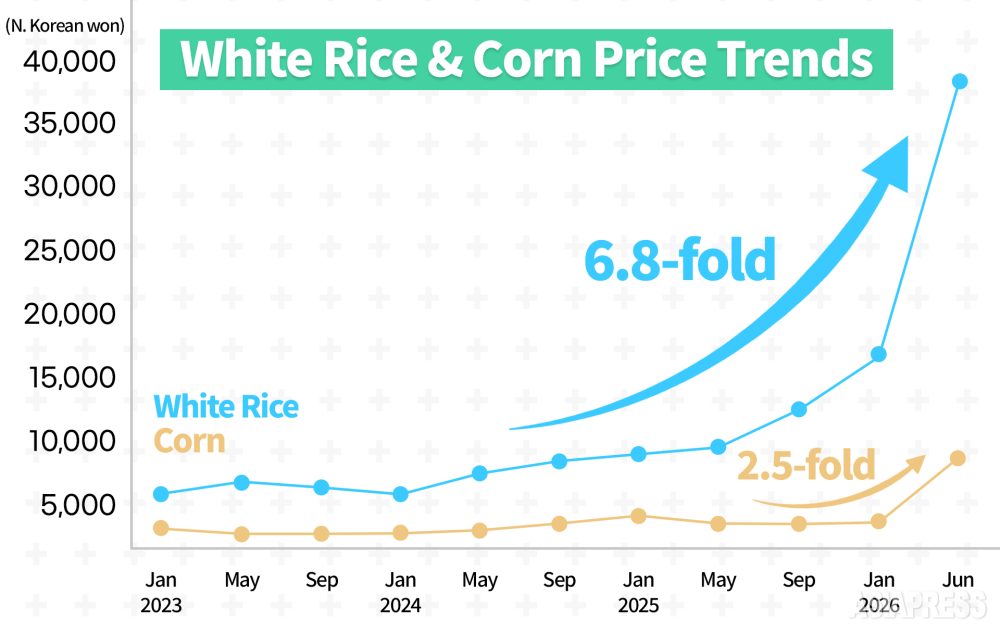
There was initial success. Taking early October 2023, just before the wage increase, as an example, ASIAPRESS surveys showed that white rice cost 6,800 won per kilogram and corn cost 3,200 won per kilogram. In other words, workers at that time could not even afford one kilogram of corn on their wages. However, shortly after the increase, in early January 2024, assuming a wage of 50,000 won, workers could purchase 8.8 kilograms of white rice or 16.1 kilograms of corn.
While this was insufficient for an entire family, compared with thirty years during which wages had been completely meaningless, the measure appeared groundbreaking. With the coronavirus pandemic having severely restricted individual economic activities and people no longer able to engage freely in market activities as before, there was a sense of relief among the population that they could at least survive for the time being.
◆Hyperinflation Destroys the Plan
But that relief was short-lived. Prices at grain distribution stores began to skyrocket. As mentioned repeatedly throughout this series, the hyperinflation of the past three years has turned the Kim Jong-un regime's new "livable wage" system into bubbles overnight. Comparing prices between shortly after the increase and the present (August 28, 2026), white rice has surged 6.5-fold and corn has soared 5.5-fold.